forward to The Appendicular Skeleton
forward to The Appendicular Skeleton
The skeleton of the vertebrate trunk and tail is a series of homologous vertebrae, each with associated pairs of dorsal and ventral ribs which in observable animals are more or less reduced; let us also include the fin seam, the unpaired fin extending around the body in some fishes which in most fishes is reduced to tail, dorsal, and anal fins. Dorsal ribs are reduced or absent in most tetrapods. In fish, dorsal and ventral ribs may be of similar size, but rib pairs may be fused into single vertical ribs.
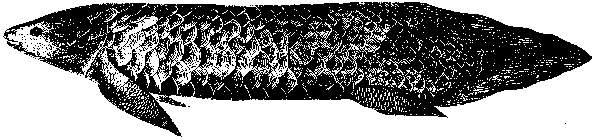
Lungfishes such as the one in Fig.3 are particularly interesting in view of the proposed model, since the tail and appendicular fins are so similar, suggesting homology. The overall shape of the lungfish is similar to that of the proposed protovertebrate. For various reasons, paleontologists have long considered these animals to be among the earlier vertebrates.
Figure 3. Australian lungfish.
Under the proposed model, the rays of the fin seam are formed from the ends of the ribs. Evolutionary differentiation of rays from ribs is facilitated by the rays' projecting beyond the body envelope. Rays and ribs follow different evolutionary paths: ribs tend to diminish in number but become thicker bony structures, while fin rays maintain high numbers and evolve a cartilaginous structure. Bone is the primitive substance of these parts under this model; cartilaginous adult structures result when mutations arrest development while the bone is in a cartilaginous embryonic stage.
Having differentiated into distinct kinds of structures, ribs and rays follow independent evolutionary paths of reduction, distortion, migration, etc. This is not a case of one part (a radial or rib) becoming two distinct parts (ray and rib); the primitive radial consists of many segments.
The evolutionary trend toward loss of axial segments is well known; in our own species, the tail has been lost. But there are many popular phylogenetic claims which contradict the pattern of reduction in number of segments. It is claimed, for example, that snakes, which have many vertebral segments, have evolved from reptiles with fewer segments. This claim is based on the fossil evidence showing early reptiles with fewer segments than snakes, and the lack of early fossils showing snakes with many segments. This argument requires the assumption that the fossil record of early vertebrates is fairly complete, and that the principle of reduction and specialization of segments may be contravened.
I suggest that many-segmented ancestors of snakes did exist in the Paleozoic Era but that we happen to lack fossil evidence of them, and that the pattern of reduction in number of segments does generally hold in vertebrate lineages after the formation of the protovertebrate. Snakes are unlikely to be fossilized, as they are adapted to move in mud, which can mire and entomb tetrapods or fishes.
Those who strive to explain elaborative evolution sometimes claim that number of segments in a train such as the vertebral column can be increased simply by a mutation that inserts complete segments into the series. Richard Dawkins suggests that such additions may be accomplished "easily", through "a simple process of duplication" (Dawkins 1986). I argue that such a mutation would be like parabiosis, but with the additional attached body accidentally reduced to the form of one perfect segment and accidentally positioned perfectly within a series of segments; this seems virtually impossible.
There is variation in the number of segments in a given species, but variants with more segments than usual only represent that end of the species' range of variation. New segments are not evolved, but old segments may be re-expressed. A variant with more segments might be well-adapted under new circumstances, giving rise in time to a species with a higher average number of segments than the ancestral species. This theoretical possibility is recognized. But the evidence implies that if this sort of evolution occurs, it is only a rare counter-eddy within the tide of evolutionary reduction in number of segments.
It may be that the constraint against adding new segments has facilitated evolution; a more chaotic and unlimited range of mutations might ultimately not have been as effective in evolving successful species.
forward to The Appendicular Skeleton